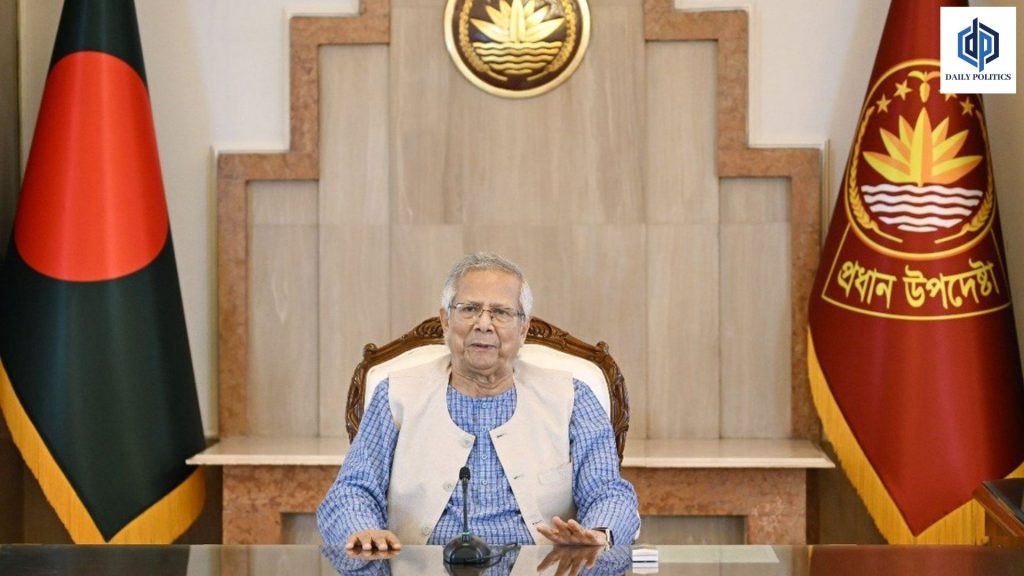
The referendum on the implementation of the July Charter will take place in the first half of next February, coinciding with the thirteenth national parliament election, announced Chief Adviser Professor Dr Muhammad Yunus.
He made this proclamation during his national speech on Thursday, November 13, at noon.
The principal adviser stated, “After evaluating all pertinent issues, we have resolved that the referendum will be conducted on the day of the forthcoming national parliamentary election.” The referendum, similar to national elections, will take place on the same day in early February. This will not impede the objective of reform in any manner. The polls will be more celebratory and economical. Essential legislation will be instituted at the suitable moment for conducting the referendum.
He noted that the questions on the referendum ballot had been formulated in accordance with the July Charter, stating, ‘I am currently reviewing the question before you.’ The inquiry will be as follows—
Do you concur with the ideas for constitutional reform outlined in the July National Charter (Constitution Reform) Implementation Order, 2025, and the July National Charter?
a) Throughout the electoral period, the caretaker government, the Election Commission, and other constitutional entities will be established in accordance with the procedures outlined in the July Charter.
b) The forthcoming parliament will consist of two chambers. An upper house comprising 100 members will be established in accordance with the votes garnered by the parties in the National Assembly elections, and a majority approval from the upper house members would be necessary to modify the constitution.
c) To execute the 30 proposals ratified by the political parties in the July National Charter concerning various matters, including enhancing women’s representation in Parliament, electing the Deputy Speaker and the President of the Parliamentary Committee from the opposition party, restricting the Prime Minister’s term, augmenting presidential powers, broadening fundamental rights, and ensuring the independence of the judiciary and local government. The victorious parties will be mandated.
d) Additional measures specified in the July Charter will be executed as pledged by political parties.
During the referendum, voters may articulate their stance by casting a ‘yes’ or ‘no’ vote on a singular question about these four concerns.
Should the majority in the referendum vote ‘yes’, a constitutional reform council will be established, comprising elected representatives, in the subsequent legislative elections. Professor Muhammad Yunus stated that these representatives will concurrently function as members of the National Parliament.
The principal adviser stated that the council will amend the constitution within 180 working days from the commencement of its inaugural session. Within 30 working days following the completion of the constitutional revision, the upper house will be constituted in accordance with the proportion of votes obtained in the legislative elections. It will be valid until the final working day of the lower house.