The United States has confirmed that American officials will meet with Russian representatives in Abu Dhabi to facilitate negotiations aimed at concluding the Ukraine conflict, following a night of reciprocal air assaults between Russia and Ukraine.
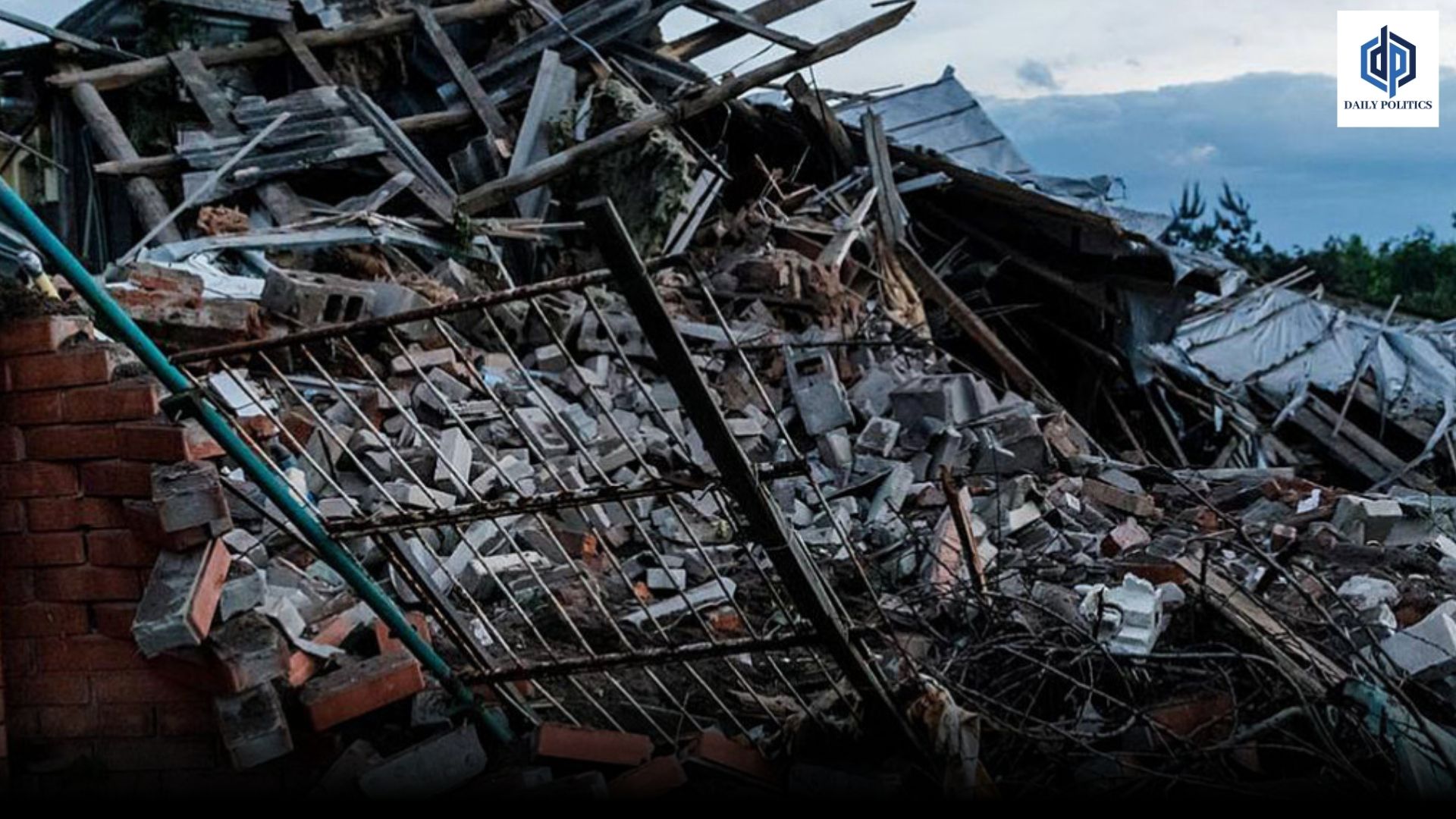
Kyiv officials reported that a minimum of six individuals were killed in Russian attacks on the city, whilst Russian officials stated that at least three fatalities occurred due to a Ukrainian strike in the Rostov region.
The recent assaults follow Ukrainian President Volodymyr Zelensky’s endorsement of suggested modifications to the contentious 28-point US peace plan.
On Sunday, officials from the US and Ukraine convened in Geneva to discuss the draft plan, which has drawn criticism from leaders in Kyiv and Europe for being overly accommodating toward Russia.
Ukraine’s European allies have developed a revised version of the plan after discarding elements that supported Russia’s military objectives.
“The list of essential steps to conclude the war is now feasible,” Zelensky stated on Monday. “Numerous accurate components have been integrated into this framework.”
Rustem Umerov, Ukraine’s national security head, stated that Kyiv anticipates arranging President Zelensky’s visit to the United States “at the earliest appropriate date in November” to negotiate with President Donald Trump.
A Kremlin spokesman dismissed the modifications as “entirely unconstructive”. On Tuesday, a US official told the BBC that its team would meet with Russian representatives in Abu Dhabi to discuss further.
Russian Foreign Minister Sergei Lavrov, who is absent from the meeting, stated that the Kremlin has not yet received the “interim” version of the revised plan, asserting that Moscow believes it should embody the “spirit and letter” of the Alaska discussions between Trump and President Vladimir Putin in August.
Additionally, a virtual conference of a “coalition of the willing” comprising Ukraine’s European allies is scheduled for Tuesday to discuss recent developments, UK Prime Minister Sir Keir Starmer stated.
The most recent negotiations occurred amidst nocturnal attacks exchanged between Russia and Ukraine.
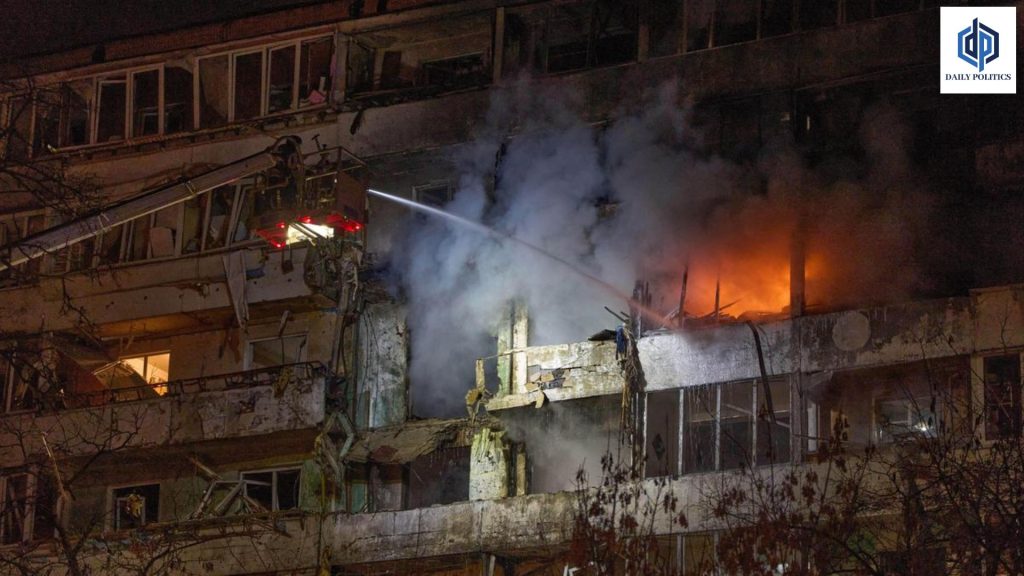
Tymur Tkachenko, the chief of Kyiv’s military administration, reported that a fire broke out at a high-rise residential building in the Dniprovskyi neighbourhood, prompting the evacuation of its inhabitants.
Emergency services reported that 18 individuals, including three children, had been rescued, and the hunt for other victims continued after the fire was contained.
According to Kyiv’s mayor, Vitali Klitschko, residents of a high-rise apartment in the central Pechersk neighbourhood were evacuated following a fire sparked by strikes.
He stated that the structure sustained damage to the upper levels; however, the fire had been extinguished.
Ukraine’s air defence troops reacted to the assault as detonations reverberated throughout Kyiv, prompting civilians to seek refuge in subterranean parking facilities and bunkers.
Ukraine’s Ministry of Energy has verified a “massive, coordinated enemy assault” against the nation’s energy infrastructure facilities.
Zelensky reported that 22 missiles and over 460 drones were deployed on Ukraine overnight.
NATO deployed four aircraft over Romania, marking the third instance in four days that its planes had been dispatched to intercept drones in the vicinity of Ukraine’s border. Six Russian drones were identified in Moldova.
The Russian defence ministry reported the interception of 249 Ukrainian drones overnight, including those over the Black Sea and Kursk.
In Russia’s Rostov region, officials said that the death toll from a Ukrainian strike had increased to three, following initial claims of one fatality.
Yuri Sliusar, the acting governor of Russia’s Rostov region, reported that two individuals succumbed at the hospital.
One death was reported in Taganrog, where Mayor Svetlana Kambulova pledged “necessary response measures.”
Ten additional individuals sustained injuries in the attacks.
Governor Veniamin Kondratyev characterised Ukraine’s overnight shelling on the southern Krasnodar area as “one of the most sustained and massive attacks by the Kyiv regime.”
The proposed peace plan, formulated by US and Russian officials last month, has generated significant concern in Ukraine and among its European allies, who contend it is excessively advantageous to the Kremlin.
White House press secretary Karoline Leavitt dismissed the notion that the Trump administration was “not engaging with both sides equally in this conflict.”
Following discussions in Geneva between the United States and Ukraine, Trump indicated that “something positive may be occurring,” but cautioned: “Do not trust it until you witness it.”
Zelensky expressed his approval of the planned modifications, stating that the “primary issue” was Putin’s insistence on legal acknowledgement of the region annexed by Russia.
Counterproposals, allegedly formulated by the UK, France, and Germany, omitted any acknowledgement of Russian-occupied territories, increased Ukraine’s authorised military strength, and permitted the possibility of Ukraine’s accession to NATO.
Russia has persistently insisted on the complete departure of Ukraine from the entirety of the eastern Donbas, comprising the Donetsk and Luhansk regions. The armies of Moscow also control Crimea and significant portions of two additional areas, Kherson and Zaporizhzhia.
Kaja Kallas, the European Union’s foreign policy chief, stated that the ultimate peace plan must render any future invasion by Moscow unfeasible and asserted that Russia should “definitely not” be allowed to rejoin the G8.
During an interview on BBC Radio 4’s Today show on Tuesday, she stated: “We cannot revert to business as usual… how could one conceive of that?”
Since the commencement of Russia’s full-scale invasion in February 2022, tens of thousands of soldiers and civilians have died or been injured, and millions have been displaced from their homes.